

Views: 0 Author: Site Editor Publish Time: 2026-09-12 Origin: Site


Automakers face a crucial turning point in vehicle design today. They are rapidly shifting focus from battery capacity to powertrain optimization. Major OEMs have finally hit the upper limits of cost-effective energy storage systems. Standard industrial motor laminations simply cannot withstand the immense mechanical stress of modern powertrains. Legacy core designs often melt under the severe thermal loads of continuous operation at 15,000+ RPM. You need precision-engineered components built specifically for these extreme environments to prevent catastrophic system failures on the road. This article provides powertrain engineers and procurement teams with a rigorous, evidence-based evaluation framework. We will thoroughly evaluate advanced core materials, cutting-edge lamination techniques, and strict manufacturing tolerances. You will learn exactly how to hit demanding efficiency targets while maintaining long-term thermal stability across all vehicle platforms.
Specifying ultra-thin electrical steel (0.20mm–0.30mm) directly correlates with achieving low core loss at high frequencies, though it introduces stamping and handling complexities.
The interplay between the EV stator core (managing thermal dissipation) and the EV rotor core (managing mechanical stress) dictates the functional limits of torque output.
Achieving high power density requires a rigorous evaluation of lamination bonding methods (e.g., interlocking vs. glue-bonding) to prevent eddy current bridging and insulation degradation.
Supplier selection must hinge on demonstrable IATF 16949 compliance, finite element analysis (FEA) validation capabilities, and scalable tooling lifecycles.
Engineers face a monumental task in modern vehicle development. The drive for extended vehicle range puts the onus directly on the motor. We must convert over 95% of stored electrical energy into mechanical output. You cannot achieve this efficiency using outdated industrial architectures. Legacy cores waste significant energy as useless heat. This directly limits the overall driving range.
High-speed constraints present a massive engineering hurdle. Increasing rotational speeds (RPM) is the fastest way to boost overall motor output. However, higher RPMs exponentially increase iron losses within standard cores. These losses manifest in two distinct forms. First, hysteresis losses occur as magnetic domains constantly flip direction. Second, high frequencies induce strong eddy currents. These localized circular currents act as severe electrical friction. They generate massive amounts of unwanted heat.
You must also manage severe thermal and mechanical risks. Motors spinning at 15,000 RPM generate immense centrifugal forces. These forces will cause physical rotor deformation if the material yield strength is compromised. Even a millimeter of expansion can destroy the delicate air gap. Furthermore, thermal bottlenecks lead to rapid and premature degradation. Excess heat quickly breaks down copper winding insulation. It can also cause irreversible permanent magnet demagnetization. Once magnets lose their flux strength, the motor suffers permanent performance failure.
Relying on standard industrial lamination thicknesses for high-speed applications.
Ignoring the exponential relationship between frequency and eddy current generation.
Failing to account for maximum centrifugal load during peak acceleration phases.
Selecting the correct electrical steel requires balancing conflicting physical properties. Engineers primarily evaluate various Silicon (Si) steel grades. Adding silicon increases the electrical resistance of the steel. This naturally reduces heat-generating eddy currents. However, higher silicon content makes the metal brittle. You must balance high magnetic permeability against raw physical yield strength. Permeability drives torque generation. Yield strength ensures high-speed rotor integrity.
Electrical Steel Grade Trade-Offs
Material Type | Silicon Content | Yield Strength (MPa) | Magnetic Permeability |
|---|---|---|---|
Standard Non-Oriented | Low to Medium | 300 - 400 | Very High |
High-Strength Steel | Medium | 450 - 600 | Moderate |
Ultra-High-Strength | High (Alloyed) | > 650 | Low to Moderate |
Optimizing the EV stator core demands precise geometric engineering. You must optimize slot geometry and tooth width perfectly. The goal is to maximize the copper fill factor. More copper allows higher current flow without overheating. However, narrowing the stator teeth too much saturates the magnetic circuit. This saturation throttles the torque output completely. You must also evaluate critical thermal pathways. Engineers constantly debate direct-oil versus water-jacket cooling interfaces at the stator boundary. Direct-oil cooling actively extracts heat directly from the windings. Water-jacket cooling provides a safer, isolated thermal boundary.
Designing the EV rotor core introduces different complex variables. You must manage structural integrity at extreme speeds ranging from 15,000 to 25,000 RPM. Most modern designs utilize Interior Permanent Magnet (IPM) rotors. These architectures require incredibly precise bridge and rib designs. The metal bridges must be strong enough to contain the magnets during peak rotation. Yet, they must remain thin enough to prevent severe magnetic flux leakage paths. Thick bridges short-circuit the magnetic field, instantly degrading motor efficiency.
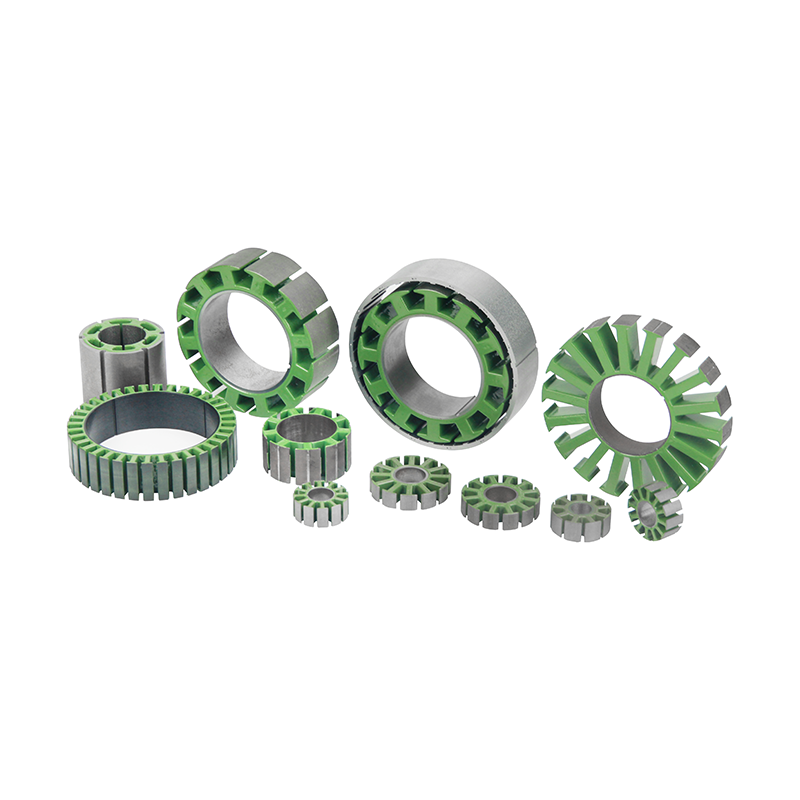
Automakers define motor success using extremely strict criteria. The ultimate goal is achieving maximum kilowatts per kilogram (kW/kg). You must hit this target without crossing predefined thermal thresholds. Achieving true high power density requires rethinking conventional manufacturing limits. Engineers are now pushing the boundaries of geometric tolerances and assembly methods.
Lamination thickness is the most critical design variable. The industry is rapidly transitioning from 0.35mm to 0.25mm or even 0.20mm electrical steel. This transition fundamentally changes motor behavior. Thinner laminations restrict the physical space for eddy currents to form. This directly enables the crucial goal of low core loss at high switching frequencies. However, this implementation reality is harsh. Stamping ultra-thin steel increases the risk of microscopic edge burrs. It requires vastly tighter stamping tolerances and superior tool maintenance protocols.
Bonding and assembly techniques directly impact final performance. You must evaluate how the core is held together.
Interlocking and Welding: This traditional approach is highly robust and easily scalable. Manufacturers stamp mechanical interlocks directly into the steel. They follow this up with external weld seams. Unfortunately, welding melts the steel locally. This degrades magnetic properties at the weld seam. It also introduces unwanted electrical shorts between individual laminations.
Adhesive and Resin Bonding: This method represents the emerging standard for high-performance EVs. Manufacturers apply a micro-thin layer of epoxy between every lamination. This entirely eliminates short circuits across the core stack. It dramatically dampens acoustic noise and improves dimensional stability. However, thermal curing times can negatively impact mass manufacturing scalability.
Lamination Assembly Performance Comparison Chart
Assembly Method | Magnetic Degradation | Acoustic Dampening | Manufacturing Scalability |
|---|---|---|---|
Interlocking | Moderate | Low | Excellent |
TIG / Laser Welding | High (at seams) | Low | Excellent |
Adhesive Bonding | None | Superior | Moderate (requires curing) |
Heat generation remains the ultimate enemy of powertrain efficiency. Iron losses directly convert electrical potential into trapped heat. This internal heating severely threatens the continuous power rating of the vehicle. A motor might output 300 kW for ten seconds. However, thermal saturation might limit its continuous output to just 100 kW. You must manage this heat proactively to ensure highway cruising speeds remain viable.
Evidence-oriented testing is absolutely non-negotiable here. Many engineering teams mistakenly rely on peak-power marketing claims. They utilize overly optimistic boundary conditions during finite element analysis (FEA). Instead, steady-state thermal modeling must account for dynamic, real-world drive cycles. You should always validate the electric vehicle motor core against the Worldwide Harmonised Light Vehicle Test Procedure (WLTP). This reveals true thermal bottlenecks during repetitive acceleration and braking phases.
Thermal expansion risks pose another severe threat to reliability. Different materials expand at completely different rates under heat. The copper windings expand faster than the steel core. The steel core expands differently than the surrounding aluminum housing. These differential expansion rates cause massive internal physical stress. Over thousands of heating and cooling cycles, this leads to stress fracturing. It can also permanently alter the critical air gap between the rotor and stator. Altered air gaps immediately reduce motor efficiency and increase acoustic whining.
Conduct FEA simulations using the harshest WLTP cycle data available.
Match the thermal expansion coefficients of potting resins to the core materials.
Implement distributed temperature sensors directly within the stator slots during prototyping.
Choosing the right manufacturing partner determines the success of your powertrain program. You must utilize a strict evaluation framework for procurement. The core is not a simple metal block. It is a highly sensitive electromagnetic component. You need to audit an EV motor core manufacturing partner based on their engineering rigor, not just their production volume.
Tooling and stamping precision are paramount. You must assess the supplier's progressive die stamping capabilities deeply. Micro-level burr control is absolutely non-negotiable. Burrs create physical electrical bridges between individual steel laminations. This instantly causes massive core loss spikes during operation. A premium supplier maintains burr heights strictly below 10% of the total material thickness. If they cannot guarantee this tolerance, they cannot support a high-performance EV program.
Quality assurance and traceability separate top-tier suppliers from standard vendors. You must require in-line electromagnetic testing for all raw materials. Suppliers should utilize Epstein frame testing routinely. This verifies the magnetic properties of the incoming steel coils before stamping begins. Furthermore, demonstrable IATF 16949 certification is mandatory. This automotive quality standard ensures strict process controls. You should also demand localized supply chain redundancy. This completely mitigates catastrophic production halts during global logistical disruptions.
Next-step actions for procurement teams involve strategic prototyping. You should always request prototype runs before committing to expensive hard tooling. Suppliers often use wire-EDM or laser cutting for early prototypes. However, you must deeply understand the magnetic performance delta between these methods. Laser cutting introduces localized heat-affected zones. This makes the prototype perform slightly worse than the final stamped product. Engage suppliers who can accurately model this performance gap for your engineering team.
The motor core is definitively not a commodity part. It serves as the fundamental architecture dictating all EV performance metrics. High torque output, maximum energy efficiency, and long-term thermal management are mutually dependent variables. They are all strictly controlled by your initial core design choices. Specifying thinner steel or adhesive bonding alters the entire vehicle behavior.
Your most actionable next step is proactive collaboration. You must encourage your internal engineering teams to engage suppliers extremely early. Bring them into the initial electromagnetic simulation phase. This early alignment perfectly matches theoretical material selection with realistic, scalable manufacturing tolerances. Bridging this gap ensures your motor achieves both peak performance and high-volume production viability.
A: A hybrid motor core design often faces much stricter spatial packaging constraints. Engineers frequently use flat, pancake-style motors. Hybrids also face unique thermal challenges due to their immediate proximity to the hot internal combustion engine. This requires distinct lamination geometries and higher-temperature insulation materials compared to standard pure EV cores.
A: Thinner laminations physically restrict the formation of heat-generating eddy currents. By generating significantly less internal heat, the motor delays thermal saturation. This thermal headroom allows the motor to run at much higher continuous power outputs for longer durations before the software aggressively throttles performance to protect the windings.
A: Adhesive bonding maintains complete electrical insulation between every single steel layer. This entirely prevents interlaminar eddy currents. It also completely eliminates the localized heat-affected zones caused by standard welding. Welding permanently degrades the magnetic properties of the steel at the seam, which lowers overall motor efficiency.


