

Views: 0 Author: Site Editor Publish Time: 2026-09-30 Origin: Site


Selecting tooling for motor core manufacturing requires balancing upfront CapEx against long-term piece-part costs. This fundamental engineering dilemma directly shapes your financial success. You must navigate these choices carefully to protect your profit margins over the product lifecycle. Demand for high-efficiency motors in EVs, robotics, and industrial automation increases daily. Engineers face a critical crossroads. They must choose between dedicated tools, like compound dies, and continuous progressive stamping setups.
Picking the wrong tooling method often leads to high scrap rates or wasted capital investment. This guide provides a strict, evidence-based framework to evaluate different tooling types. We will explore volume limits, material utilization, and equipment constraints in detail. By the end, you will know exactly which setup fits your specific production floor and long-term manufacturing goals.
Volume Thresholds: Dedicated rotor stator stamping tools offer lower upfront costs and rapid deployment for low-to-medium volumes, while progressive stamping dies require high initial investment justified only by high-volume continuous production.
Precision Realities: Both methods can achieve strict stamping die precision, but progressive dies introduce accumulated tolerance risks across multiple stations that require advanced strip layout engineering.
Equipment Constraints: Progressive setups demand specific press capabilities (e.g., 200-ton+ presses with long beds), whereas dedicated single-hit or compound tools offer more flexibility in press selection.
Motor core manufacturing presents a clear operational bottleneck. You must align your initial tooling investment directly to your product lifecycle. Engineers often struggle to balance upfront expenses against ongoing production realities. High-volume runs demand durability, while low-volume runs require agility. Producing laminations requires extreme repeatability across thousands or millions of cycles. This makes the cheapest initial tool a dangerous choice for modern production floors.
Poorly built tools often result in unacceptable long-term scrap rates. High scrap destroys profitability over time. lamination stamping inherently demands tight tolerances to ensure optimal magnetic flux. Every micro-burr degrades motor efficiency and increases core loss. You need a solid baseline for evaluation before contacting vendors or cutting steel. You cannot guess these parameters.
First, identify your precise Annual Estimated Usage (EAU). You must know exactly how many parts you will produce annually. Next, define your required concentricity limits and dimensional tolerances. Finally, audit your available press floor capabilities carefully. Knowing these exact metrics helps you properly shortlist a custom stamping tool. This structured approach prevents catastrophic capital misallocations and ensures smooth production launches.
Dedicated rotor stator stamping tool setups operate uniquely in the press room. Vendors often configure them as compound dies or single-station notching tools. These tools cut the inner and outer diameters simultaneously. They perform this cutting action in a single stroke or a highly controlled indexed sequence. The material does not travel through complex carriers.
Advantages:
These dedicated tools offer superior concentricity for complex geometries.
They maintain excellent flatness because the part remains stationary during the cut.
You avoid moving the fragile metal strip across multiple forming stations.
This straightforward design significantly lowers your initial die cost.
It also guarantees a faster time-to-market for iterative new designs.
Limitations:
These setups inherently produce much slower cycle speeds.
They demand higher labor and manual handling costs on the floor.
Workers must manually handle blanks or operate secondary indexing machines.
They remain largely unsuitable for massive-scale, continuous runs.
Ideal Use Cases:
Engineers favor these tools heavily for prototyping new motor designs. They perfectly suit specialized, low-volume industrial motors. You also see them used extensively in precision metal stamping for robotic joint assemblies. These specific applications feature lower overall volumes but demand extremely high part complexity and strict tolerance adherence.
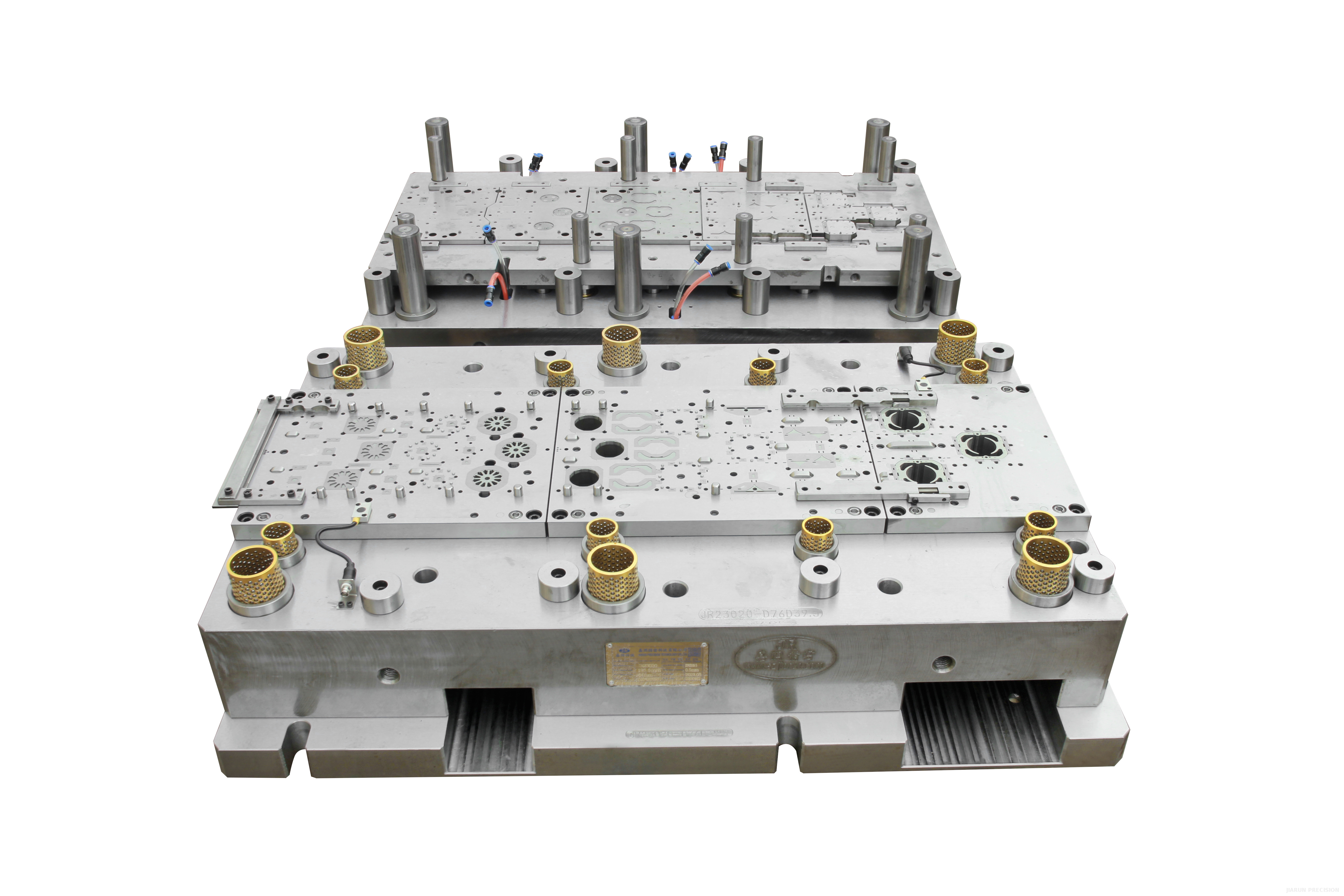
The progressive stamping die process relies entirely on continuous automation. You feed a continuous metal coil through multiple sequential stations. The stations perform piercing, blanking, and interlocking operations step by step. A finished lamination drops out at the end of the press stroke. The strip carrier holds everything together during transit.
Advantages:
This heavy automation drastically reduces your per-part labor costs.
You achieve high-speed output effortlessly, often hitting hundreds of strokes per minute.
Engineers easily integrate in-die auto-skewing or automated interlocking features.
This in-die capability eliminates tedious downstream assembly steps entirely.
Limitations:
These complex dies require immense engineering and machining costs.
You face a massive upfront CapEx hurdle before producing a single part.
They remain incredibly difficult and expensive to modify once fully built.
They generate higher baseline material waste if engineers fail to optimize the strip layout.
Ideal Use Cases:
These continuous systems dominate high-volume automotive EV motor core production worldwide. They serve standard appliance motors reliably and efficiently. They also stamp mass-market HVAC components at tremendous scales, where fractions of a penny matter deeply to profitability.
Evaluating these distinct methods requires looking closely at material utilization. Progressive setups introduce a harsh engineering reality to your budget. Inefficient strip layouts compound material waste rapidly at high volume scale. Electrical steel costs remain exceptionally high in the current market. You must compare this continuous feeding waste against the nested capabilities of dedicated dies. Compound setups nest blanks tightly, saving highly valuable silicon steel on every hit.
Precision matters equally when selecting your core approach. You must achieve strict stamping die precision for modern motor cores. Compound tools maintain flat and concentric relationships effortlessly. The single-hit operation eliminates complex movement variables entirely. Conversely, progressive tools push the material across 10 or more active stations. They require robust piloting systems to prevent severe micro-misalignments during transit.
Consider your tooling maintenance intervals carefully before finalizing a decision. Progressive tools require complex, multi-station maintenance routines from skilled technicians. Sharpening one station often forces you to shim others precisely to match heights. You contrast this against maintaining a singular motor core die. The single-station tool sharpens uniformly, predictably, and quickly, reducing overall machine downtime.
Evaluation Criteria | Compound Stamping Tool | Progressive Setup |
|---|---|---|
Initial Capital Investment | Low to Moderate | Extremely High |
Typical Production Speed | Slow to Medium | Very Fast |
Concentricity Control Method | Inherent (Single Stroke Cut) | Requires Strict Piloting Systems |
Maintenance Complexity | Straightforward and Fast | Complex (Multi-station Shimming) |
Material Utilization | Highly Efficient Nesting | Carrier Strip Creates Waste |
You cannot ignore the physical equipment constraints on your shop floor. Tooling decisions must match your existing or planned capital equipment strictly. Ignoring these boundaries leads to immediate deployment failures.
Press Tonnage and Bed Size: A massive progressive setup cannot run on standard, compact machinery. It requires specialized, heavy-duty infrastructure to function safely. You typically need rigid 200-ton or larger stamping presses for these jobs. The press must handle severe off-center loading dynamically. It also needs a highly extended bed to support long die shoes securely.
Material Behavior and Grain: Electrical steel behaves unpredictably under high cutting pressure. Silicon steel brittleness affects both tooling environments significantly during production. You must focus intensely on strict edge burr control. Excessive burrs destroy magnetic property preservation during the cut, ruining motor performance. Precision clearances prevent this degradation and extend punch life.
Sensor and Fault Integration: Continuous production introduces severe collision risks. You absolutely need modern in-die sensors for multi-station tools today. These sensors prevent catastrophic die crashes by detecting misfeeds instantly. Misfeeds happen in milliseconds at high speeds. Sensor integration adds necessary implementation complexity but saves hundreds of thousands in repair costs.
Evaluating a motor core tooling supplier requires strict technical diligence. You must look far beyond the initial quoted price. Assess their core engineering capabilities directly to ensure a successful partnership.
Ask for Strip Layout Simulations: A credible partner provides finite element analysis (FEA) upfront. They should share detailed strip layout drafts before cutting any tool steel. This simulation proves their design minimizes costly material waste and prevents carrier strip deformation.
Verify Tryout Capabilities: Ensure they possess robust in-house presses matching your exact production environment. They must seamlessly replicate your tonnage, stroke, and speed parameters. They need to validate the tool physically under realistic conditions before shipping it to your facility.
Inspect the Quality Lab: Examine their measurement infrastructure critically during your audit. Look for advanced CMM data capabilities and optical measurement systems. They must prove they can measure the required tolerances precisely under realistic, high-volume production conditions.
The choice between dedicated single-hit tools and continuous multi-station dies involves deep strategic planning. It is not about discovering which technology is inherently better overall. It is about aligning the chosen method strictly with your specific volume trajectory and capital structure. Low volumes thrive beautifully on simple, precise tooling setups. Massive production runs demand robust, automated, sequential solutions to remain profitable.
We strongly advise your procurement and engineering teams to act collaboratively early in the design phase. Audit your expected three-to-five-year production volumes immediately. Assess your current press room capabilities honestly and thoroughly. Do you actually have the tonnage and bed size required for massive progressive tools?
Take proactive steps today to secure your manufacturing future. Request a comprehensive tooling feasibility analysis from a highly qualified engineering partner. Ask them for a preliminary strip layout consultation. This data-driven approach clearly defines the exact production economics for your specific motor core design.
A: You should typically consider transitioning when volumes exceed hundreds of thousands to millions of units annually. At this massive scale, the labor savings and speed of progressive dies justify the high initial CapEx. However, material thickness, part complexity, and equipment availability also heavily dictate this exact tipping point.
A: An optimized strip layout drastically reduces silicon steel scrap. Since electrical steel remains highly expensive, minimizing waste is critical. The long-term material savings from a brilliant layout often pay for the higher initial tooling cost over the tool's lifecycle.
A: Generally, no. Running these tools requires specific, extended bed lengths and adequate tonnage, often exceeding 200 tons depending on part size. It also demands strict press parallelism to handle off-center loading and prevent rapid, uneven die wear.
A: Dedicated compound tools often deploy in a few weeks due to simpler designs. Progressive dies require significantly longer lead times, frequently spanning several months. This longer timeframe accounts for complex multi-station design, extensive machining, intricate sensor integration, and rigorous tryout phases.


